




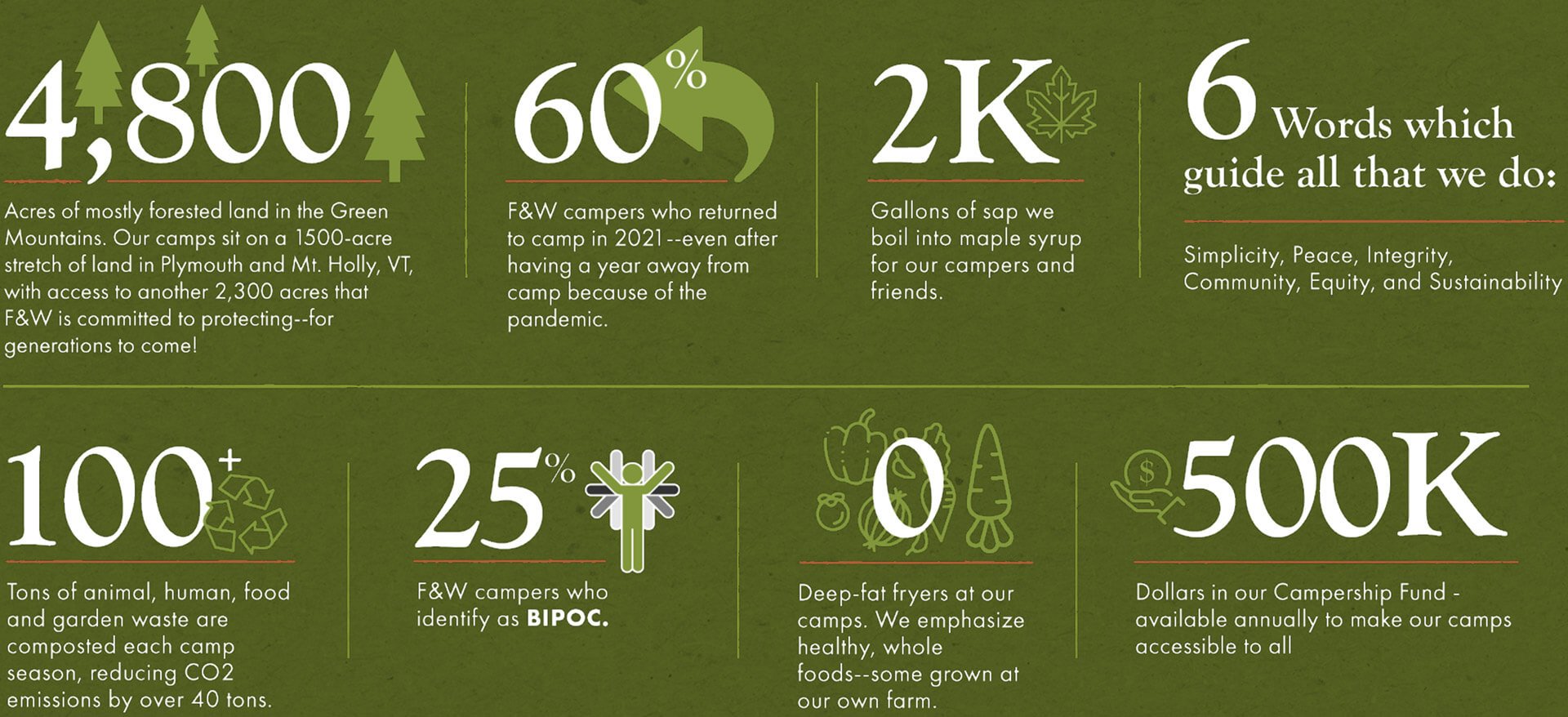
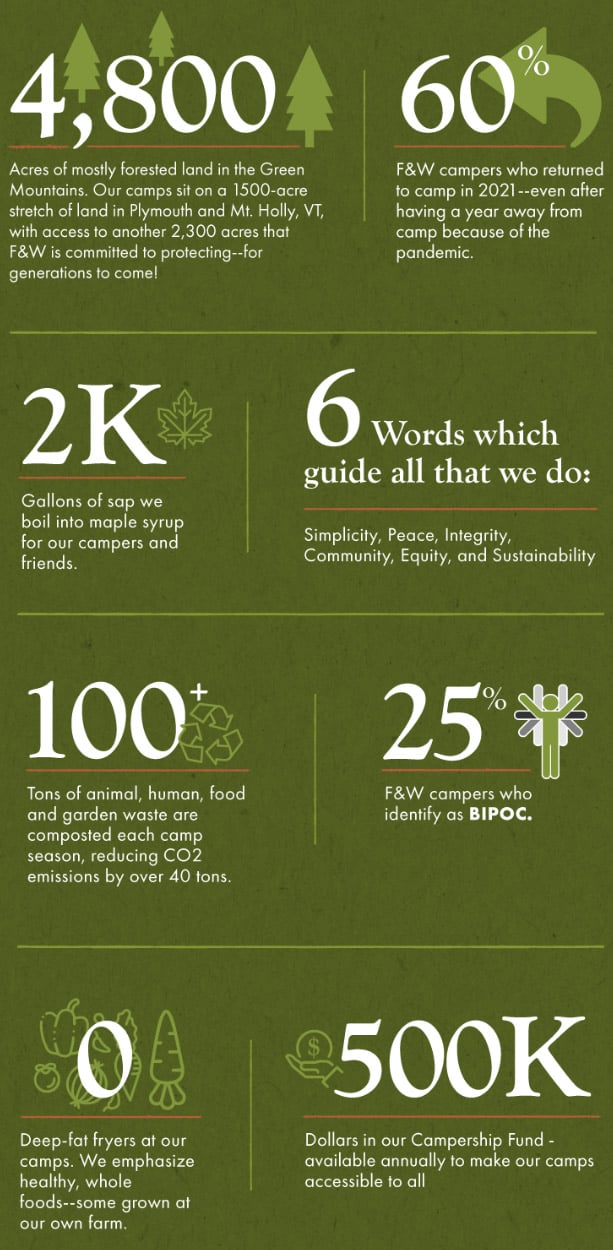
Farm & Wilderness By The Numbers

F&W Blogs
On a warm September afternoon in Philadelphia, I sat down with Bill Schwarzschild, age 88, whose eyes still light up when he talks about his first ride to camp in 1950. Picked up at White River Junction in an open-body stake truck—a mode of transportation that would raise eyebrows today—Bill was about to begin an adventure that would shape not just his summers, but his entire life.
.png?width=470&height=470&name=Bill%20Schwartzchild%20Blog%20image%20(1).png)
When $600 Could Save a Life
In 1950, Bill's parents paid $600 to send him to camp—equivalent to over $8,000 today. But this wasn't just about summer fun. With a polio epidemic in Philadelphia that claimed over 300 lives that summer, families who could afford it sent their children away from the cities. "I was glad my parents could afford it," Bill reflects. "I had a bunch of friends with polio."
What they got for that investment was transformative. Bill credits his F&W experience with literally saving his life during his eight years in the Air Force, where he learned to lead based on what he learned in the Vermont wilderness. "It taught me to be comfortable in the woods. Self-reliance," he says. When asked what F&W should never stop doing, his answer was immediate: "Teaching self-reliance."
The More Things Change, The More They Stay The Same
Bill's memories paint a picture of camp life that would be both familiar and foreign to today's families. There was no electricity except at the Main Lodge, where square dances were held on nights when they fired up the generator.
Some details have evolved—what Bill knew as "Submarine Island" (now Paradise Island) got its name from how the dam's opening and closing affected access. They had "The Monster" and they would take out the center section and see who could run back and forth ten times without losing their balance.
And there were hippies before the term “hippie” existed. The F&W gardener’s three children were all named after medicinal plants and his first co-counselor went everywhere with a barn owl on his shoulder. “It lived in the cabin with us. It stunk! The kids hated it! “
Lessons in Humanity
Perhaps most remarkably, one of Bill's favorite counselors was a young German named Pete Schiller. This was just after World War II, and Bill's Jewish family had lost 15 members in the Holocaust. Yet this experience became "one of the best experiences of my life to that point, as I learned that not everybody of one group was bad."
This wasn't unusual for the progressive-minded Webb's, who were also hiring Japanese staff like Tatsuo Arima, who would later serve as a UN diplomat. The commitment to diversity and inclusion—revolutionary for the 1950s—remains a cornerstone of F&W values today.
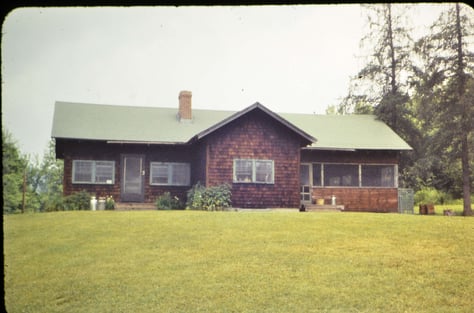 Tamarack Farm, 1950
Learning to Make Your Own Fun
"One summer it rained all the time," Bill remembers, "and we just took cardboard boxes and slid down the hill. The idea was to learn to have fun. And to take care of yourself... to learn how to live in the wilderness." This is reminiscent of "Mattress Sliding", which campers still enjoy on wet days.
This resourcefulness, this ability to find joy in simplicity, echoes through every F&W generation. The spirit remains the same: creativity, resilience, and the confidence to solve problems with whatever's at hand. Whether it's sliding down hills on cardboard in 1950 or using cardboard for banquet decorations, there is an ongoing culture of making magic from very little.
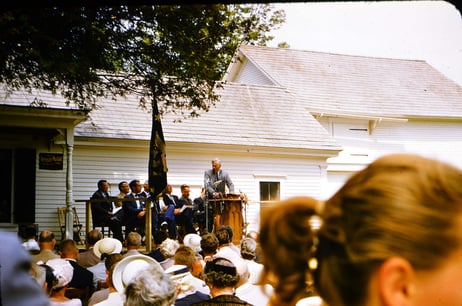 Robert Frost reading his poems at the Calvin Coolidge Birthplace
A Legacy That Endures
Bill went on to become a Scoutmaster for many years, crediting his F&W experience with making his troop successful. He served eight years in the Air Force, where wilderness skills learned at camp quite literally kept him alive. His own son attended Timberlake and became "a world-famous marine biologist and ecologist, teaching and running the Atlantic Coast Lab for UVA."
Throughout his life, Bill continued to give back—he started the library at Indian Brook (now Firefly Song) and supported the camp financially throughout his business career. When people ask where he grew up, his answer is always: "At The Farm & Wilderness Camps."
The Thread That Connects Us All
As I listened to Bill's stories, I was struck by how much has changed—and how much hasn't. Today's campers arrive by car and bus rather than stake truck, but they still experience that same mix of excitement and nervousness heading into the unknown. They have electricity in the lodge without needing a generator, but not the cabins. Most of all they still learn to find joy in simple pleasures and form deep connections with counselors who become lifelong influences.
The camping industry has evolved dramatically since 1950, but F&W's commitment to its core values remains unwavering. Joyful play, purposeful work and rugged outdoor living—these aren't just nice ideas from a bygone era. They're the living, breathing heart of what makes F&W extraordinary, generation after generation.
Bill's parting wisdom rings as true today as it did 75 years ago: "The idea was to learn to have fun. And to take care of yourself." In a world that seems to change faster every year, some things—the most important things—remain beautifully, powerfully constant.
What F&W memories connect you across the decades? We'd love to hear your stories of how camp shaped your life. Share them with us here.

Clearing The Path
When Tate Hausman reached out to me this winter with a special request, I knew we had something meaningful ahead of us. His son Lincoln's grandfather Bob had one simple holiday wish: a family camping trip at the site of the former Flying Cloud. There was no place he'd rather be than returning to this special place that had shaped so many lives.
After clearing the administrative hurdles, I was fortunate to join the Hausman family for what became a beautiful demonstration of how "work is love made visible."
The Journey In
The entry to the site remains as challenging as ever, accessible only to large trucks without significant risk. The Hausmans courageously navigated the numerous dips and potential bottoming-out sections in their Toyota Sienna. While they made it through, Mike the Logger later reported that the cover for the oil pan had been sacrificed somewhere along the trail on their way out—a small price paid for this meaningful pilgrimage.
Three Generations, One Purpose
What struck me most about this visit was the beautiful level of intention present throughout our time together. The trip consisted primarily of clearing brush from the numerous trees downed by ice and wind storms over the past 24 months, along with sweeping out and tidying up the Round House.
Bob Hausman, who served as Flying Cloud Director from 1966-67, exemplified this intentionality perfectly. While clearing a path, he made sure it was wide enough for a counselor to walk side by side with a camper. As he explained, "It's about more than getting from A to B, it's about having the conversations." Even in this maintenance work, the educational philosophy as a Director shone through.

The family shared stories that brought the site's history to life, including tales of "The Great Leap Backwards" in 1968—led by Bob's brother—when the feeling was things had gotten "too high tech". This change was primarily about getting rid of the noisy generator to pump water, but donkey also got the boot!
Learning from Experience
Lincoln shared valuable insights about the practical realities of camp operations that will inform our future planning. One detail that surprised me: a pile of brush as tall as my head will likely all be used in a single day. It's easy to underestimate such quantities when you haven't lived the camp experience.
He also showed me the circle where obsidian chips were historically found and turned into necklaces and other crafts—a tangible connection to the land's deeper history and the hands-on learning that defined Flying Cloud.
Former Executive Director Len Cadwallader also hiked in to join our efforts, adding another layer of institutional memory to our work.
Looking Forward: Damage Assessment and Future Plans
The winter storms left their mark on the outhouse infrastructure. Two KYBOs took hits from downed trees. The KYBO above the trail near the Meeting area sustained repairable damage. However, the Drumming KYBO's fate was sealed when a massive tree, downed by lightning, fell directly upon it. A new era will indeed bring a new KYBO.

As I looked ahead to programming returning to this clearing in the woods in 2026, I asked Bob about the ideal capacity. I was surprised to hear "40-50" as a perfectly manageable number of campers. While we'll likely start with about 32-36 maximum for the new program, it's encouraging to know we have room to grow.
The Road Ahead
We're targeting Memorial Day weekend 2026 for a work crew of 24-30 people to camp and prepare the site for the first sessions the F&W Base Camp program of 2026 summer season. This will likely include constructing that new KYBO and addressing the various maintenance needs we identified during this visit as well as... clearing brush!
If you're interested in being part of this site preparation effort, please click here to fill out the survey to help us plan for the Memorial Day weekend work session.
This family visit reminded me that Farm & Wilderness's greatest strength has always been its people—the connections formed, the lessons learned, and the love for this special place that spans generations.
About the Family Members:
Bob Hausman: TL camper '53-56, TF 57-58, TL staff 59-64, FC Director 65-66.
Rick Hausman: TL camper 55-59: TF 1960; Counselor Apprentice (CA) at TL, 1961; counselor at FC (under Brother Bob’s direction), 1965; FC director, 1968-70; F&W Board Member in the 1970s and 80’s; [Editor of the Interim, ’69-70; helped establish Camp Seaforth, 1970; Ninevah Foundation Board Member.
Nate Hausman: TL 90-'91, FC camper '92-'95, FC counselor '99-'04, FC co-director '04-'06.
Tate Hausman: Went to camp as Dan Hausman: TL 86-91, TF 92, TL staff 94.
Lincoln (Wolf) Hausman: TL '18-23, FC 21-23, TF 24-25
(There are more Hausmans, this is who made it on the trip!)
A message from Alisha Carberry, Clerk, F&W / FWC Board of Trustees :
Dear F&W Community,
I hope this message finds you well as we move into what promises to be an exciting 2025 at Farm & Wilderness.
It is with tremendous joy and excitement that I announce, on behalf of the Board of Trustees, the appointment of Jay Kullman as Executive Director of Farm & Wilderness and Farm & Wilderness Conservation.
Many of you already know Jay from his 17 years of dedicated service to our organization. He has worn many hats during his time with us—leading our farm and facilities development, spearheading conservation projects, and most recently serving as Interim Executive Director since November. Throughout all of these roles, Jay has consistently demonstrated exceptional leadership, unwavering dedication to our mission, and a deep commitment to the values that make Farm & Wilderness special.
.jpg?width=450&height=600&name=Image%20(6).jpg)
Jay truly lives our mission of joyful play, purposeful work, and rugged outdoor living. He has been a supportive colleague, a respected member of our broader community, and a friend to many. The Board considers ourselves incredibly fortunate to have him leading us forward.
Please join me in congratulating Jay and wishing him well as he steps into this important role. I'm confident that under his leadership, Farm & Wilderness will continue to be a place where young people can grow, discover themselves, and develop a deep connection to the natural world.
With gratitude and excitement for what lies ahead,

Alisha Carberry
Clerk, F&W / FWC Board of Trustees
.png?width=300&height=300&name=Alisha%20(1).png)